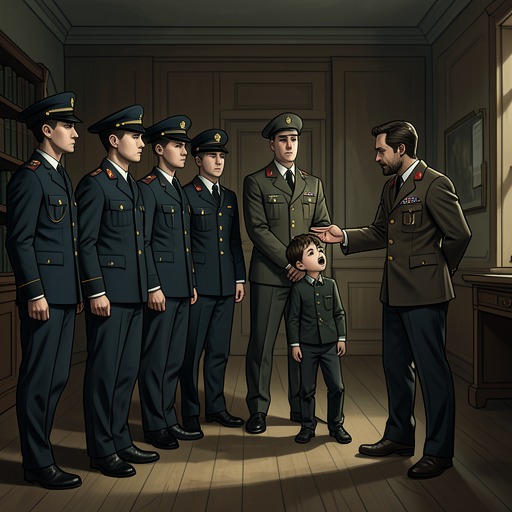
Schulpforta's test of the weakest cadet
All the Light We Cannot SeeSchulpforta’s test of the weakest cadet is a recurring disciplinary ritual in which a boy must identify a supposedly weaker classmate, who is then given a head start before the other cadets are ordered to chase him. Under Bastian’s supervision, the exercise turns weakness into a public label and the boys into instruments of punishment; its escalating violence tests Werner Pfennig’s willingness to resist as well as Frederick’s capacity to endure.
The rule and its first use
Bastian presents the cadet corps as a body whose weaknesses must be driven out, twirling a rubber hose near the boys as he explains the principle. The exercise gives that abstract doctrine a procedure: a selected cadet names the weakest member of the group, and the named boy must reach Bastian before his classmates catch him. The commandant supplies a ten-second head start, then releases the pursuers with a raised hand. His pistol hangs at his belt, while his manner makes the threat behind the drill difficult to mistake.
One October afternoon, Bastian selects Bäcker and asks him to identify the weakest cadet. Bäcker points to Ernst Somebody, a slow runner whose long, uncoordinated stride makes him an easy target. When Bastian gives the signal, Ernst runs toward the distant commandant while fifty-nine fourteen-year-olds race after him. Werner stays among the pursuing boys, bewildered by the purpose of the chase but aware, at a more instinctive level, of what capture would mean. He even finds himself irritated that Ernst is not faster. Ernst reaches Bastian a split second before the pack catches him, escaping the immediate consequence of the ritual without changing its rules.
Frederick becomes the target
On a later, windy afternoon, Bastian selects Helmut Rödel, a small boy who keeps his hands balled into fists, and asks him to name the corps’s weakest member. Rödel points directly at Frederick. Werner feels the choice land heavily: Frederick is his friend, and the ritual has now turned its arbitrary designation into a threat against someone he knows. Frederick appears distracted rather than visibly afraid, blinking as though his attention has not yet caught up with the field around him. Werner tries to meet his eyes, then hisses for him to run.
The rules offer Frederick little protection. Bastian walks farther away than before, but counts quickly; Frederick has gone only about twenty yards when the signal releases the cadets. Though he is a decent runner and faster than Werner, the snow slows him, while the fastest boys pursue with unusual urgency. They bring him down fifteen strides from Bastian. The chase ends not in safety but in a circle of panting cadets, Frederick standing amid them as Bastian orders Rödel to take up the rubber hose. Rödel strikes Frederick across the shoulder, then the jaw. Frederick withstands a third blow; on the fourth he raises his arms, and Rödel continues striking his hands, shoulders, and face. Bastian watches and urges the punishment onward. Werner remembers Frederick’s patience in the woods and his ability to identify distant warblers by their songs, yet he cannot make himself intervene. The beating stops only after Frederick has fallen facedown in the snow.
The selection is repeated until the test becomes a pattern of pursuit and assault rather than an isolated drill. Three times in nine days, Frederick is named the weakest. Bastian lengthens the run to four or five hundred yards, often over deep snow, and shortens the time before the pursuers are released. Each time the cadets catch Frederick; each time Bastian watches him being beaten; each time Werner does nothing to stop it. Frederick endures seven blows before falling, then six, then three. He neither cries out nor asks to be excused, and his refusal to perform fear seems only to intensify Bastian’s anger. The exercise thus makes obedience collective: one cadet points, another runs, the group hunts, and Werner’s silence leaves the commandant’s violence unopposed.
Werner tries to bury himself in Dr. Hauptmann’s laboratory, where he has built a transceiver prototype and tests its fuses, valves, handsets, and plugs. The technical work does not free him from what he has witnessed. His stomach troubles him, he develops diarrhea, and he wakes at night imagining Frederick in his Berlin bedroom, wearing his glasses and tie while freeing birds trapped in the pages of a huge book. The image carries the friend’s gentleness into Werner’s disturbed sleep, while the school itself seems to grow darker around the repeated assaults.
The test’s aftermath
The ritual’s official language presents it as a test of fitness, but its procedure offers no fair measure of strength: a cadet is publicly marked as weak, given a head start that Bastian can shorten or undermine, and then exposed to a pursuers’ violence. The widening distance and faster countdown in Frederick’s case make the outcome increasingly predetermined. Once the chase ends, the group does not protect the boy it has caught; it gathers around him while Bastian turns the exercise into a beating. The designation therefore works less as a judgment than as permission: it gives the commandant a victim and the cadets a sanctioned role in harming him.
More than a year later, Werner visits Frederick in a grand drawing room where the furniture and open boxes make him seem small. He still wears his black-framed glasses, but someone must feed him porridge by the spoonful; it clings to his whiskers and to the place mat beneath him. Frederick does not raise his eyes to Werner. The scene measures the distance between the boy who endured the field’s blows without crying out and the young man who now depends on another person for basic care. The test has ended, but its damage remains present in the altered body and in Werner’s inability to look at the porridge on the table.
The rhetoric of the exercise
Every afternoon, whatever the weather, Bastian gathers the fourteen-year-olds outside and frames death as a choice between fighting like a lion and disappearing as one of the nobodies. The test of the weakest turns that rhetoric into a drill: the boys are taught to identify weakness in one another, pursue its chosen embodiment, and accept punishment as the proper consequence of being caught. Yet Frederick’s repeated selection exposes the contradiction in Bastian’s lesson. The exercise is presented as a measure of fitness, but its rules are manipulated against the chosen boy, and endurance brings no reprieve. When Rödel points to Frederick, Bastian’s narrowed expression gives way to open malice; the commandant’s talk of strengthening the corps becomes a license to hurt a defenseless cadet. The ritual’s discipline therefore lies not in fair competition but in making the boys enact its violence—and making Werner’s failure to intervene part of what it teaches.